Modern websites are expected to do much more than display static information. Users want interfaces that respond immediately to their actions, update information without unnecessary page reloads, display personalized content, and provide smooth experiences across desktop and mobile devices. Building these experiences with plain HTML, CSS, and JavaScript is possible, but as an application becomes larger, managing its interface and application logic can become increasingly difficult. This is one of the reasons frontend libraries and frameworks have become an important part of modern web development.
React.js is one of the most widely used JavaScript libraries for building interactive user interfaces. It allows developers to divide an application into reusable components, manage changing data through state, respond to user interactions, and create interfaces that update when application data changes. Instead of manually manipulating every part of a webpage, developers describe what the interface should look like for a particular state, and React manages the process of updating the user interface.
React is particularly useful for single-page applications, dashboards, social platforms, e-commerce websites, learning management systems, and other products where users interact with changing information. It can also be used in server-rendered and static-generation architectures through frameworks built around React.
In the previous posts of this Web Development series, we explored HTML, CSS, JavaScript, backend development with Node.js and Express.js, MongoDB, and authentication and authorization. React adds an important frontend development capability to that foundation. It can connect to the backend APIs discussed earlier and display the data returned by those services in a structured, interactive interface.
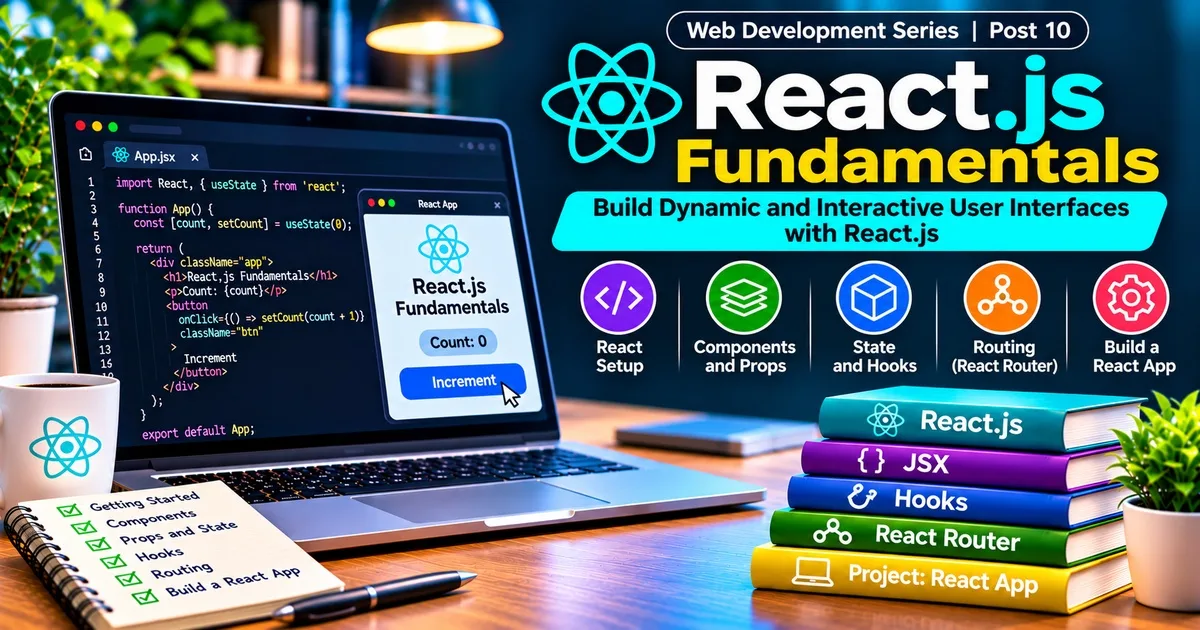
This article introduces React.js from the ground up. It explains components, JSX, props, state, event handling, conditional rendering, lists, Hooks, forms, API integration, routing, project organization, performance, testing, and practical development principles. By the end, you will understand how React applications are structured and how to begin building a real frontend project.
Continue Reading
1. What Is React.js?
React.js is an open-source JavaScript library for building user interfaces. It was originally developed at Meta and is now maintained through an open-source ecosystem. React focuses primarily on the interface layer of an application. It helps developers describe the visual structure of a page and keep that structure synchronized with changing application data.
A traditional website may use JavaScript to find an HTML element, change its text, update its attributes, and modify its appearance whenever something happens. This approach works for small interactions, but manually coordinating many interface updates can become difficult as an application grows. React offers a declarative model. Developers describe the interface based on the current data, and React handles the updates required when that data changes.
For example, imagine a notification panel displaying the number of unread messages. When a new message arrives, the application updates the relevant state. React then renders the updated notification count. The developer does not need to manually locate the counter element and replace its text every time the value changes.
React is a library rather than a complete application framework. It does not prescribe every part of an application's architecture. Developers commonly combine React with additional tools for routing, server communication, form management, testing, and build processes. This flexibility makes React suitable for many kinds of projects, but it also means that teams must make thoughtful decisions about their technology stack.
2. Why Developers Use React
One of React's main strengths is its component-based architecture. A component represents a reusable part of an interface, such as a navigation bar, product card, login form, profile section, or dashboard widget. Components can be combined to build larger interfaces without repeating the same markup and behavior throughout the application.
React also provides a consistent way to manage changing interface data. State represents information that can change over time, such as whether a menu is open, which tab is selected, or which products are present in a shopping cart. When state changes, React updates the parts of the interface that depend on it.
Another benefit is the surrounding ecosystem. Developers can choose from tools for routing, data fetching, testing, styling, animation, and application frameworks. React skills are also relevant across many industries because businesses use it to build customer-facing websites and internal applications.
React supports incremental adoption as well. A team does not always need to rebuild an entire website to use React. In suitable situations, React can be introduced into a particular part of an existing application. This can help organizations modernize interfaces gradually.
However, React is not automatically the best choice for every website. A simple static page may not need a JavaScript framework. React introduces dependencies, build tooling, and additional concepts that should be justified by the needs of the application. Choosing technology based on project requirements is more important than choosing it simply because it is popular.
3. Understanding the Component-Based Architecture
A React application is built from components. Each component is a unit of interface structure and behavior. A component can contain text, buttons, images, forms, other components, and application logic.
Consider an e-commerce website. The page may contain a header, navigation menu, search bar, product grid, product cards, shopping cart summary, and footer. Instead of building the entire page as one large component, developers can create smaller components for these sections.
A product card can be reused for every product in a catalog. The product information changes, but the basic structure remains the same. The same header component can appear across multiple pages. A shared button component can maintain consistent appearance and behavior throughout the application.
A simple React component looks like this:
function WelcomeMessage() {
  return (
    <section>
      <h1>Welcome to our platform</h1>
      <p>Explore articles, discussions, and opportunities.</p>
    </section>
  );
}

export default WelcomeMessage;
The function returns JSX describing the interface. The component can then be imported and used inside another component.
React components should generally have a clear responsibility. A component that handles an entire page, performs several unrelated tasks, manages complex data transformations, and contains many different interface sections may be difficult to maintain. Dividing such a component into smaller units improves readability and makes individual parts easier to test and reuse.
4. What Is JSX?
JSX stands for JavaScript XML. It is a syntax extension that allows developers to describe interface elements using markup-like expressions inside JavaScript code. JSX is commonly used with React because it makes component structures easier to read.
A JSX expression may look similar to HTML, but it follows JavaScript and React rules. For example, the className attribute is used instead of the HTML class attribute. JavaScript expressions can be inserted inside JSX using curly braces.
function UserProfile() {
  const userName = "Alex";
  const role = "Frontend Developer";

  return (
    <div className="profile-card">
      <h2>{userName}</h2>
      <p>{role}</p>
    </div>
  );
}
The expressions inside curly braces are evaluated as JavaScript. This makes it possible to display variables, calculate values, call functions, and render content based on application data.
JSX must follow a valid structure. A component should return one enclosing element, although a React Fragment can be used when an additional DOM element is unnecessary.
function PageHeading() {
  return (
    <>
      <h1>Learning React</h1>
      <p>Building modern interfaces with reusable components.</p>
    </>
  );
}
JSX is transformed into JavaScript that React can process. Developers generally do not need to perform this transformation manually because modern build tools handle it.
5. Setting Up a React Development Environment
Before creating a React application, you need a working JavaScript development environment. Node.js provides the runtime used by many React development tools, while npm or another package manager installs and manages project dependencies.
A modern way to start a React project is to use a supported development tool such as Vite. Vite provides a development server and build process suitable for many client-side React applications.
You can create a new project using the following commands:
npm create vite@latest my-react-app -- --template react
cd my-react-app
npm install
npm run dev
The first command creates a React project using the selected template. The second moves into the project directory. The third installs dependencies, and the final command starts the development server.
The browser can then display the application using the local address printed by the development tool. Changes made to the source files are reflected during development through the tool's update mechanism.
A typical starter project contains source files, a package configuration file, an entry HTML file, and build-tool configuration. The exact structure may differ according to the template and tooling version. Developers should understand the purpose of the files instead of treating the generated project as a collection of files that must never be changed.
6. Understanding the Structure of a React Application
Most React applications have an entry point that connects the JavaScript application to an element in the HTML document. The entry point creates the React root and renders the top-level component.
A simplified entry file may look like this:
import { StrictMode } from "react";
import { createRoot } from "react-dom/client";
import App from "./App.jsx";
import "./index.css";

createRoot(document.getElementById("root")).render(
  <StrictMode>
    <App />
  </StrictMode>
);
The HTML document contains the root element where the React application is mounted. The App component acts as the main application component and can contain other components.
A small project might use the following structure:
my-react-app/
  public/
  src/
    components/
      Header.jsx
      Footer.jsx
      ProductCard.jsx
    pages/
      Home.jsx
      About.jsx
    App.jsx
    main.jsx
    index.css
  package.json
This structure is an example rather than a universal requirement. Smaller applications may not need separate page directories, while larger projects may organize files by features instead of by component type. The most useful structure is one that helps the team locate related code and understand how application responsibilities are divided.
7. React Props: Passing Data Between Components
Props, short for properties, allow a parent component to pass information to a child component. They make components reusable because the same component can display different information depending on the props it receives.
Consider a product card. Instead of writing a separate component for every product, developers can create one card component and pass the product name, price, and image as props.
function ProductCard({ name, price }) {
  return (
    <article className="product-card">
      <h2>{name}</h2>
      <p>Price: {price}</p>
    </article>
  );
}

function ProductList() {
  return (
    <div>
      <ProductCard name="Wireless Mouse" price="₹799" />
      <ProductCard name="Mechanical Keyboard" price="₹2,499" />
    </div>
  );
}
The ProductCard component receives the values through its function parameters. Each instance renders different content while sharing the same structure.
Props are read-only from the receiving component's perspective. A child component should not directly modify the props it receives. If information needs to change, the application should manage that change through state or another appropriate data-management mechanism.
Props can also pass functions. This allows a child component to notify its parent when an action occurs. For example, a product card may receive an onAddToCart function and call it when the user selects an Add to Cart button.
8. Understanding State in React
State is information that a component manages and that can change over time. Examples include a counter value, a selected tab, a form input, a shopping cart, or the result of an API request.
When state changes, React schedules the component to render again so that the interface reflects the updated information. This is one of the central ideas behind React's declarative model.
React provides the useState Hook for managing local state in function components.
import { useState } from "react";

function Counter() {
  const [count, setCount] = useState(0);

  function increaseCount() {
    setCount(currentCount => currentCount + 1);
  }

  return (
    <div>
      <h2>Count: {count}</h2>
      <button onClick={increaseCount}>Increase</button>
    </div>
  );
}

export default Counter;
The useState call returns the current state value and a setter function. The initial value in this example is zero. When the user selects the button, the setter updates the state, and React renders the updated count.
State should be updated through its setter rather than modified directly. For example, changing an array stored in state with a mutating method can cause unexpected behavior because React relies on state updates to determine when rendering is needed. Developers should create new arrays and objects when updating state.
9. Handling Events in React
Interactive applications respond to user actions such as clicking buttons, submitting forms, typing in input fields, and selecting options. React provides event handlers that allow components to respond to these interactions.
Event names in JSX use camelCase. For example, onClick handles click events, onChange handles changes to form controls, and onSubmit handles form submission.
function AlertButton() {
  function showMessage() {
    alert("Your action was received.");
  }

  return (
    <button onClick={showMessage}>
      Click Here
    </button>
  );
}
The event handler is passed as a function reference. Writing onClick={showMessage} allows React to call the function when the event occurs. Writing onClick={showMessage()} would call the function during rendering, which is usually not the intended behavior.
For forms, developers commonly prevent the browser's default page submission and handle the data within the React application. The submitted information can then be validated and sent to a backend API.
10. Conditional Rendering
Conditional rendering means displaying different interface content depending on a condition. A dashboard may show a loading message while data is being retrieved, an error message if a request fails, and the actual content when the request succeeds.
JavaScript conditions can be used inside React components to determine what should be rendered.
function AccountStatus({ isLoggedIn }) {
  if (isLoggedIn) {
    return <h2>Welcome back!</h2>;
  }

  return <h2>Please sign in to continue.</h2>;
}
The ternary operator is also useful for shorter conditions:
function LoginButton({ isLoggedIn }) {
  return (
    <button>
      {isLoggedIn ? "Open Dashboard" : "Sign In"}
    </button>
  );
}
For conditions where content should appear only when a value is true, developers can use logical AND:
{hasNotifications && <NotificationPanel />}Conditional rendering is useful for access-aware interfaces, but it should not be confused with backend authorization. Hiding a button does not protect the corresponding API endpoint. The server must still verify permissions before performing sensitive operations.
11. Rendering Lists and Using Keys
Applications frequently display collections of data, including products, articles, users, comments, and notifications. React can render these collections by using JavaScript's map() method.
function ArticleList() {
  const articles = [
    { id: 101, title: "HTML Fundamentals" },
    { id: 102, title: "CSS Fundamentals" },
    { id: 103, title: "JavaScript Fundamentals" }
  ];

  return (
    <ul>
      {articles.map(article => (
        <li key={article.id}>
          {article.title}
        </li>
      ))}
    </ul>
  );
}
Each item should have a stable key that helps React identify it across updates. A database identifier is usually a good choice when it is unique and stable. Using an array index as a key can create problems when items are inserted, removed, or reordered because the index may no longer identify the same item.
Keys should be unique among the sibling elements in the rendered list. They are used internally by React and are not automatically available as ordinary props inside the component.
12. React Hooks
Hooks are functions that allow function components to use React features such as state, effects, context, and references. They make it possible to organize component behavior without relying on class components.
Hooks must follow the Rules of Hooks. They should be called at the top level of a function component or a custom Hook, not inside loops, conditions, or nested functions. This consistent calling order allows React to associate Hook state with the correct component.
The most commonly used Hooks include useState, useEffect, useContext, useRef, and useMemo. Each serves a different purpose, and developers should use them when they solve a real problem rather than adding Hooks simply because they are available.
useState
useState manages local component state. It is useful for counters, form values, toggles, filters, selected items, and other information that affects what the component displays.
useEffect
useEffect synchronizes a component with an external system. It is commonly used for subscriptions, browser APIs, timers, and certain data-fetching patterns. It should not be used automatically for every calculation or state update.
import { useEffect, useState } from "react";

function PageTitle() {
  const [title, setTitle] = useState("React Learning");

  useEffect(() => {
    document.title = title;
  }, [title]);

  return (
    <button onClick={() => setTitle("React Dashboard")}>
      Change Page Title
    </button>
  );
}
The effect runs after rendering and synchronizes the browser document title with the current state. The dependency array tells React which reactive values the effect depends on. When an effect establishes a subscription or another resource that needs cleanup, it should return a cleanup function.
useContext
useContext allows components to read values from a context provider without passing the same props through many intermediate components. It is useful for information shared across a component tree, such as a theme or authenticated user information.
Context should not automatically become the storage location for every application value. Frequently changing or unrelated state may be better managed through local state or a dedicated state-management solution.
useRef
useRef stores a mutable value that persists across renders without triggering a new render when changed. It is often used to access DOM elements, retain timer identifiers, or keep other values that do not directly determine the visible interface.
useMemo
useMemo can cache the result of a calculation between renders when its dependencies have not changed. It may help with expensive calculations, but it should not be used as a substitute for clear component design or as a default optimization for every expression.
13. Working with Forms in React
Forms are central to applications that support registration, login, search, contact requests, content creation, and data management. React can manage form values through component state, validate them, and submit them to backend APIs.
A controlled input is a form element whose value is managed by React state.
import { useState } from "react";

function SearchForm() {
  const [search, setSearch] = useState("");

  function handleSubmit(event) {
    event.preventDefault();
    console.log("Search term:", search);
  }

  return (
    <form onSubmit={handleSubmit}>
      <input
        value={search}
        onChange={event => setSearch(event.target.value)}
        placeholder="Search articles"
      />
      <button type="submit">Search</button>
    </form>
  );
}
The input displays the current state value. When the user types, the change handler updates that value. When the form is submitted, the handler can validate the data and perform the required operation.
Production forms need more than basic input handling. They should provide clear validation messages, accessible labels, suitable input types, and protection against repeated submissions. Validation should also be performed on the backend because client-side validation can be bypassed.
For complex forms, developers may use dedicated form libraries. These tools can simplify validation, field management, error display, and submission handling, particularly when a form contains many fields or conditional sections.
14. Styling React Components
React does not require one specific styling method. Developers can use regular CSS files, CSS Modules, utility-first CSS frameworks, component libraries, or other styling approaches.
A traditional stylesheet can define classes that are applied through className:
function PrimaryButton() {
  return (
    <button className="primary-button">
      Continue
    </button>
  );
}
The CSS file can then define the button's appearance:
.primary-button {
  background: #2457d6;
  color: white;
  border: none;
  border-radius: 8px;
  padding: 12px 20px;
  cursor: pointer;
}

.primary-button:hover {
  opacity: 0.9;
}
CSS Modules provide locally scoped class names, helping larger applications avoid accidental style conflicts. Utility-first frameworks provide predefined classes that can be composed directly in markup. Component libraries provide ready-made interface elements and design patterns.
Regardless of the styling method, responsive design and accessibility remain important. Components should work on different screen sizes, provide visible focus states, maintain readable contrast, and support keyboard navigation.
15. Connecting React to Backend APIs
A frontend application often needs information from a backend service. React can communicate with APIs using browser capabilities such as fetch or libraries designed for HTTP requests.
For example, a product dashboard may request product information from an Express.js endpoint. The backend retrieves the records from MongoDB and returns them as JSON. React then displays the returned data.
A simplified data-fetching component might look like this:
import { useEffect, useState } from "react";

function Products() {
  const [products, setProducts] = useState([]);
  const [loading, setLoading] = useState(true);
  const [error, setError] = useState("");

  useEffect(() => {
    const controller = new AbortController();

    async function loadProducts() {
      try {
        const response = await fetch("/api/products", {
          signal: controller.signal
        });

        if (!response.ok) {
          throw new Error("Unable to load products");
        }

        const data = await response.json();
        setProducts(data);
      } catch (err) {
        if (err.name !== "AbortError") {
          setError(err.message);
        }
      } finally {
        if (!controller.signal.aborted) {
          setLoading(false);
        }
      }
    }

    loadProducts();

    return () => controller.abort();
  }, []);

  if (loading) return <p>Loading products...</p>;
  if (error) return <p>{error}</p>;

  return (
    <ul>
      {products.map(product => (
        <li key={product.id}>{product.name}</li>
      ))}
    </ul>
  );
}
This example demonstrates loading, success, and error states, along with request cancellation during cleanup. Real applications should also consider caching, retry behavior, pagination, request deduplication, authentication, and how data changes after user actions.
For more complex applications, data-fetching tools can manage caching and synchronization more consistently than writing every request manually. Developers should understand the underlying HTTP behavior even when using a library.
16. React Router and Navigation
A multi-page application often needs different URLs for different views. For example, an application may contain a home page, product page, account dashboard, profile page, and settings page. React Router is a commonly used library for handling client-side navigation in React applications.
Client-side routing allows the application to change the displayed page without requiring a full document reload for every navigation. The router matches the current URL to the appropriate route and renders the corresponding component.
A simplified example is:
import {
  BrowserRouter,
  Routes,
  Route
} from "react-router-dom";

import Home from "./pages/Home";
import About from "./pages/About";
import Dashboard from "./pages/Dashboard";

function App() {
  return (
    <BrowserRouter>
      <Routes>
        <Route path="/" element={<Home />} />
        <Route path="/about" element={<About />} />
        <Route path="/dashboard" element={<Dashboard />} />
      </Routes>
    </BrowserRouter>
  );
}

export default App;
The route configuration connects URL paths with page components. Real applications may also need nested routes, dynamic parameters, error routes, loading boundaries, and navigation guards.
A protected route can improve the user experience by directing unauthenticated users to a sign-in screen. However, frontend route protection is not a replacement for backend authorization. The API must independently verify the user's identity and permissions.
17. Managing Shared Application State
As an application grows, several components may need access to the same information. A shopping cart, selected language, theme preference, or authenticated user may be needed in many parts of the interface.
One approach is to lift state to a common parent and pass it down through props. This works well for smaller component trees, but deeply nested components can lead to prop drilling, where values and callbacks must pass through components that do not directly use them.
React Context can help share values across a component tree. For larger or more complex state requirements, developers may choose tools such as Redux Toolkit or other state-management libraries.
The choice should depend on the application's needs. Local component state is often sufficient for small interface details. Context works well for selected shared values. Dedicated state-management tools can help when an application has complex shared state, coordinated updates, debugging requirements, or established team conventions.
It is also important to distinguish server state from client interface state. Data retrieved from an API has different requirements from a locally selected tab. Server-state libraries can manage caching, freshness, background updates, and synchronization with backend services more effectively than treating all data as ordinary local state.
18. React Performance and Optimization
A React application should provide a responsive experience, especially when displaying large lists, complex dashboards, or frequently changing data. Performance optimization begins with understanding what is actually slow rather than applying every available optimization technique.
One important technique is to keep components focused and avoid unnecessary state updates. State should be placed at an appropriate level so that unrelated components do not need to update whenever a value changes. Large lists can benefit from pagination or virtualization, which renders only the items needed for the visible area.
React provides tools such as memo, useMemo, and useCallback for specific optimization scenarios. These tools can reduce unnecessary work in suitable cases, but they also introduce complexity. Developers should measure performance and use them when there is a clear benefit.
Code splitting can reduce the amount of JavaScript that needs to be loaded initially. React supports lazy loading of components through mechanisms such as lazy and Suspense. Larger applications can use route-level splitting so that users do not need to download every page's code when they first open the website.
Images, fonts, API response sizes, and network requests also affect the perceived performance of a React application. Optimizing frontend performance requires looking at the complete user experience, not only React rendering.
19. Testing React Applications
Testing helps developers verify that components behave as expected and that changes do not introduce regressions. A useful testing strategy combines different levels of tests.
Component tests can verify that a button displays the expected label, that a form shows validation errors, or that a product card renders the correct information. Interaction tests can simulate user actions such as typing, clicking, selecting options, and submitting forms.
Integration tests can verify how multiple components work together. For example, a test may check whether submitting a login form produces the expected loading state and handles an unsuccessful API response correctly. End-to-end tests can exercise important user journeys through the application in a browser.
React Testing Library is widely used for testing components from the perspective of user behavior. Tools such as Vitest can run unit and component tests in modern JavaScript projects, while browser automation tools can support end-to-end testing.
Good tests should focus on observable behavior rather than relying heavily on internal implementation details. This makes tests more resilient when components are refactored.
20. Building a Practical React Project: A Task Management Interface
A useful beginner project is a task management interface connected to a backend API. It brings together components, state, forms, events, lists, and API communication.
The interface can contain a page heading, a form for creating tasks, a list of existing tasks, and controls for marking tasks as completed. Each task can have a title, completion status, and identifier. React manages the visible state while the backend stores the actual records.
The application can be divided into reusable components such as Header, TaskForm, TaskList, and TaskItem. The parent page coordinates the data and passes information to child components through props. The form collects new task details, and the list displays the tasks returned by the backend.
The Express.js API can expose endpoints for listing tasks, creating a task, updating completion status, and deleting a task. MongoDB can store the records. If tasks belong to individual users, the backend should associate each record with the authenticated user's identifier and enforce ownership checks on every operation.
This project also introduces practical challenges that developers encounter in real applications. They need to display loading indicators while data is retrieved, show useful error messages when requests fail, prevent duplicate submissions, and update the interface after a successful operation.
Once the basic application works, it can be expanded with search, filters, pagination, due dates, categories, and team collaboration. It can also include authentication so that each user sees only the tasks they are permitted to access.
21. Accessibility and Maintainable React Code
Accessibility should be considered while building components, not added as a final correction. Buttons should use actual button elements, navigation should use appropriate links, and forms should have clear labels. Interactive elements should be usable through a keyboard, and focus should remain understandable as the interface changes.
Developers should avoid using generic elements for every interaction when semantic HTML elements already provide the required behavior. A clickable div, for example, does not automatically behave like a button for keyboard and assistive technology users.
Maintainable React code also depends on consistent naming, clear component responsibilities, predictable data flow, and reusable patterns. Components should not become unnecessarily large. Shared logic can be extracted into custom Hooks when it represents reusable behavior.
Developers should avoid creating abstractions too early. A component or custom Hook should solve a meaningful problem rather than introduce another layer that makes simple code harder to understand. Code reviews, formatting tools, linting, and automated tests help teams maintain consistency as projects grow.
22. React and Modern Frontend Frameworks
React is often used alongside frameworks that provide additional application capabilities. These frameworks may support server-side rendering, static generation, routing conventions, data loading, and deployment features.
Next.js is a prominent React framework used to build full stack web applications. It provides routing and rendering capabilities that can help developers create pages with different rendering strategies. Other tools and frameworks may offer different approaches to application structure, server rendering, or build workflows.
Developers should understand the distinction between React itself and the frameworks built around it. React provides the user-interface foundation, while a framework can supply additional conventions and infrastructure. The best choice depends on performance requirements, search visibility, application complexity, hosting environment, and team experience.
For a small interactive application, a straightforward React setup may be sufficient. A larger website that depends on server rendering, structured routing, and advanced data-loading strategies may benefit from a React framework.
23. Learning Roadmap for React Beginners
The most effective way to learn React is to build a foundation in JavaScript first. Developers should be comfortable with variables, functions, arrays, objects, modules, promises, asynchronous operations, and array methods such as map, filter, and find. These concepts appear frequently in React applications.
After learning the basics, practice building small components and passing props between them. Next, learn state, event handling, conditional rendering, and list rendering. Build simple projects such as a counter, a search interface, a to-do list, and a form.
Once these concepts become familiar, learn Hooks, API integration, routing, and shared state. Build a project that communicates with a backend rather than relying entirely on hardcoded data. This will help connect frontend knowledge with the backend concepts covered earlier in this series.
Finally, learn testing, accessibility, performance measurement, and a React framework where appropriate. Understanding why a tool is used is more valuable than memorizing a large collection of APIs. Practical projects, debugging experience, and reading well-maintained code are important parts of becoming a capable React developer.
Conclusion
React.js provides a structured way to build interactive and reusable user interfaces. Its component-based architecture helps developers divide complex pages into smaller parts, while JSX makes interface structures readable within JavaScript. Props support communication between components, state manages changing information, and Hooks provide access to essential React capabilities.
React becomes especially powerful when combined with backend APIs. A frontend can retrieve information from an Express.js service, display MongoDB records, and provide interfaces for authentication, content management, dashboards, and other application features. Routing, form handling, state management, testing, accessibility, and performance optimization help turn individual components into reliable applications.
For beginners, the best approach is to learn the fundamentals and build progressively more capable projects. Start with small components, understand how data moves through the application, and practice connecting React to real backend services. With consistent practice, React can become a valuable tool for building modern web applications.
#ReactJS #WebDevelopment #FrontendDevelopment #JavaScript #ReactTutorial